A wider palate, at your body's pace.
A narrow upper jaw leaves your tongue too little room and makes breathing through your nose harder. BREAS uses the removable Vivos DNA appliance to remodel the palate gradually.

Led by Dr. Ameet Trivedi, Airway Health Specialist

The short answer
BREAS is our palatal remodeling protocol built on the Vivos DNA appliance, a custom, removable oral appliance worn 16 to 22 hours a day. At Airway Health Austin, Dr. Trivedi uses it to remodel the palate gradually, which can widen the upper jaw at the bone and give the tongue and nasal airflow more room.

Is this you?
If two or more of these sound familiar, it's worth a closer look.
Sleep
Breathing
Smile and jaw
The root cause
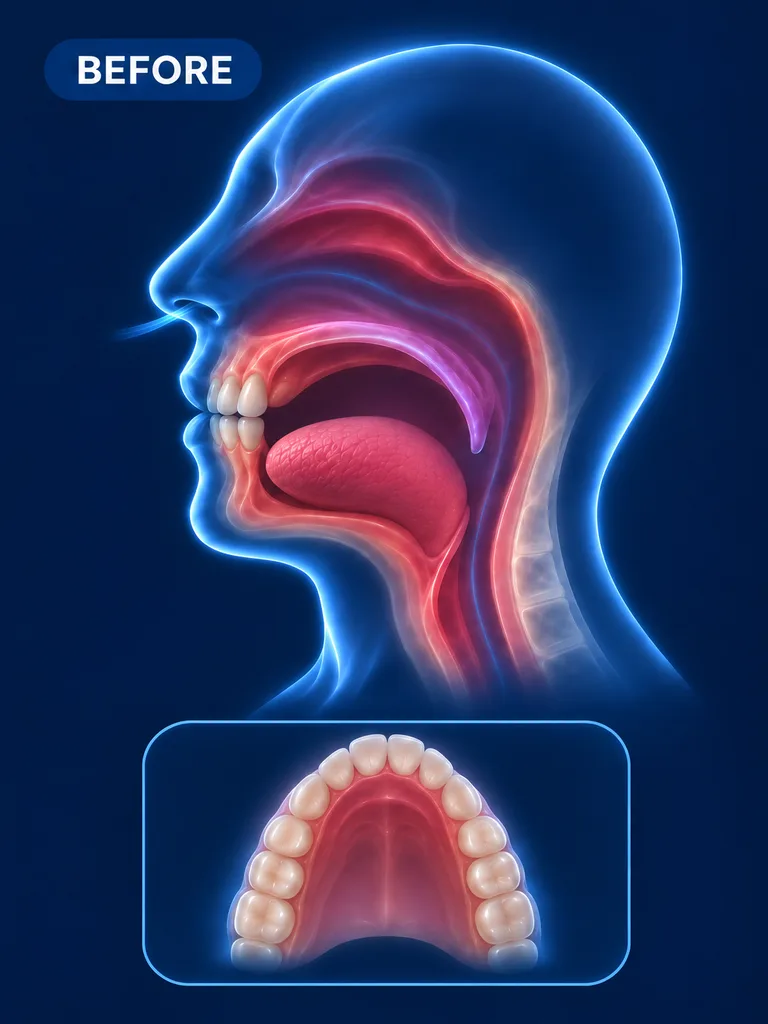
When the upper jaw does not develop to its full width, the teeth crowd and the tongue loses its place on the roof of the mouth.
The upper jaw also forms the floor of the nose. A narrow one adds resistance to nasal airflow, so mouth breathing often takes over and a low tongue sits back toward the airway.
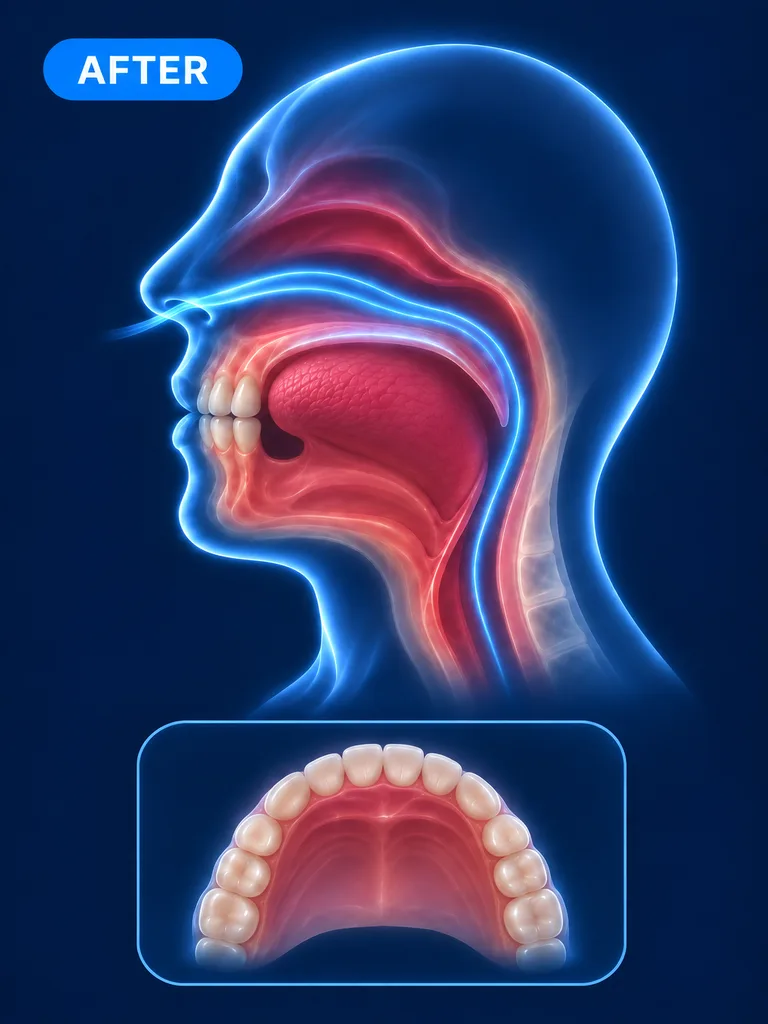
BREAS uses the Vivos DNA appliance to remodel the palate over time. Light forces work with your body's own bone remodeling, so the upper jaw can widen at the bone without rapid change.
How it works
In four steps. The appliance is adjusted a little at a time, so your palate has time to remodel at each stage.
Start with a complimentary consultationTalk through what you are noticing with an Airway Coordinator. No cost, no commitment.
Breathing, structure, and function assessed together, with CBCT imaging and an overnight sleep ring when they add clarity.
From your 3D imaging and goals, Dr. Trivedi designs your custom Vivos DNA appliance and the stages your palate remodels through.
You wear the removable appliance 16 to 22 hours a day. At regular check-ins it's adjusted gradually.
What to expect
Your Airway Evaluation uses 3D CBCT imaging to show whether jaw width plays a role. A sleep analysis can be added.
The appliance is custom-made and removable. You wear it 16 to 22 hours a day, with gradual adjustments at regular check-ins.
Expansion takes about 4 months. Orthodontic alignment follows, about 6 months, and many plans add myofunctional therapy.
Who you'll see

BREAS lets us remodel the palate gradually, at a pace the body can adapt to, for more room to breathe through the nose.
Dr. Ameet Trivedi, DDS · Airway Health Specialist, 20+ years of clinical experience
Questions
BREAS uses the removable Vivos DNA appliance, worn 16 to 22 hours a day, to remodel the palate gradually. MASPE+ is a fixed expander anchored to the palate with miniscrews that widens the upper jaw at the bone more directly. Your imaging and goals guide which one fits, and Dr. Trivedi walks you through both.
Yes. Your bone keeps remodeling into adulthood, so BREAS can widen the upper jaw at the bone in adults, gradually. The Vivos DNA appliance is also used for children ages 6 to 17. Your 3D imaging shows what is realistic for your anatomy.
BREAS runs in two parts: palate expansion with the appliance (about 4 months), then orthodontic alignment (about 6 months).
No. Braces and clear aligners move the teeth into line. BREAS works on the palate itself, remodeling the upper jaw to make room, and alignment can follow.
BREAS addresses a narrow upper jaw, a structural factor that can contribute to snoring and to symptoms associated with sleep apnea. If you add a sleep analysis, a SleepImage physician reviews it and makes any diagnosis. Results vary and are not guaranteed.
We do not bill insurance directly. We provide the codes you need to submit for reimbursement.
Start with a conversation with an Airway Coordinator. Your 3D imaging then shows whether BREAS or MASPE+ suits you.
Start here
$0
A call with an Airway Coordinator to talk through symptoms and next steps.
In Austin
$300/500
Credited toward treatment if you proceed; conditions apply.
$300 for pediatric (ages 3-12) / $500 for adults (13+)
Outside Austin
$380
Meet Dr. Trivedi by video for specialized guidance, no travel needed.
Prefer to talk now? Call (512) 500-6228
Educational only, not a substitute for professional advice. Results vary and are not guaranteed.
BREAS (Biomimetic Remodeling Expansion Aligner System) is a non-retractive, airway-focused approach that gently expands the upper jaw to improve breathing, sleep, and overall function. It works by stimulating the body’s natural ability to grow and remodel bone rather than forcing rapid change. At Airway Health Austin, BREAS is used to address the root cause of airway restriction—limited structure—so you can achieve lasting improvements in airflow, sleep quality, and health.
BREAS is a biomimetic treatment system designed to restore proper jaw structure and airway function using light, intermittent forces. Instead of simply straightening teeth, it focuses on expanding the maxilla (upper jaw), which plays a key role in breathing, tongue posture, and facial development.
When the upper jaw is too narrow, it restricts the nasal airway and limits space for the tongue. This often leads to mouth breathing, poor sleep, and compensations throughout the body. BREAS addresses this by guiding the body to remodel and adapt naturally.
This approach supports long-term stability because it works with biology—not against it.
You may benefit from BREAS airway expansion if you experience:
These symptoms often trace back to limited airway space—not just dental alignment.
Your care at Airway Health Austin begins with a comprehensive airway and structural assessment. This includes evaluating jaw width, breathing patterns, tongue posture, and, when needed, advanced imaging.
From there, a customized BREAS protocol is designed for you. Treatment focuses on gradual expansion of the upper jaw using light, biologically appropriate forces. This allows your body to adapt over time rather than forcing rapid change.
Most patients move through treatment in phases, with regular check-ins to monitor progress and adjust the appliance as needed. The goal is not just straighter teeth—but improved airway function, breathing, and long-term stability.
Adults often come in with years of symptoms—snoring, fatigue, TMJ pain, or sleep apnea—without realizing the root cause is structural. BREAS allows for expansion and remodeling even in adulthood, improving breathing and sleep without extractions or retraction.
Airway restriction often begins with a narrow upper jaw. When the maxilla is underdeveloped, it limits the size of the nasal passages and increases resistance to airflow. This makes nasal breathing more difficult and encourages mouth breathing, especially during sleep.
As BREAS expands the upper jaw, the nasal floor widens and airway volume increases. This allows for smoother airflow, improved oxygenation, and more stable breathing patterns at night.
At the same time, increased space allows the tongue to rest properly against the palate instead of falling back into the airway. This reduces the risk of airway collapse, snoring, and disrupted sleep—helping you achieve deeper, more restorative rest.
You’ll undergo a detailed medical-grade, at-home sleep study and structural airway evaluation. This helps identify sleep-disordered breathing patternas and whether limited jaw development is contributing to your symptoms. Your treatment plan is fully customized based on your anatomy and goals.
You’ll wear a BREAS appliance designed to deliver light, intermittent forces that stimulate natural bone remodeling. Adjustments are made gradually to support controlled, stable expansion.
As expansion progresses, improvements in breathing, sleep, and function often follow. In many cases, additional therapies—such as myofunctional therapy—are used to reinforce proper tongue posture and breathing patterns.
BREAS (Biomimetic Remodeling Expansion Aligner System) is an airway-focused treatment that expands the upper jaw using gentle, biologically driven forces. It improves breathing, sleep, and oral function by addressing structural limitations.
Yes. While growth is more active in children, adults can still achieve meaningful expansion and airway improvement through bone remodeling and adaptation.
BREAS runs in two parts: palate expansion (about 4 months), then orthodontic alignment (about 6 months). The focus is on gradual, stable change rather than rapid movement.
BREAS is different. Traditional orthodontics often focuses on aligning teeth, sometimes with extractions or retraction. BREAS prioritizes airway, structure, and function first—then alignment follows.
BREAS can support improved airway volume and breathing patterns, which may reduce symptoms of sleep-disordered breathing. It's often part of a comprehensive airway treatment plan.
Start with a complimentary consultation at Airway Health Austin and find out if BREAS is right for you.