Jaw pain starts with how you breathe.
When your airway narrows during sleep, an airway protective reflex clenches your jaw to help hold it open so air can flow. Night after night, that strains the joint. We treat the root cause by giving your airway more room.

Led by Dr. Ameet Trivedi, Airway Health Specialist

The short answer
TMJ pain, or temporomandibular disorder (TMD), is pain or dysfunction in the joint that hinges your jaw to your skull. At Airway Health Austin, Dr. Trivedi looks at the joint, the bite, and the airway together, because clenching at night can be the body bracing to hold the airway open.

Is this you?
If two or more of these sound familiar, it's worth a closer look.
In the jaw
Head and neck
At night
The root cause
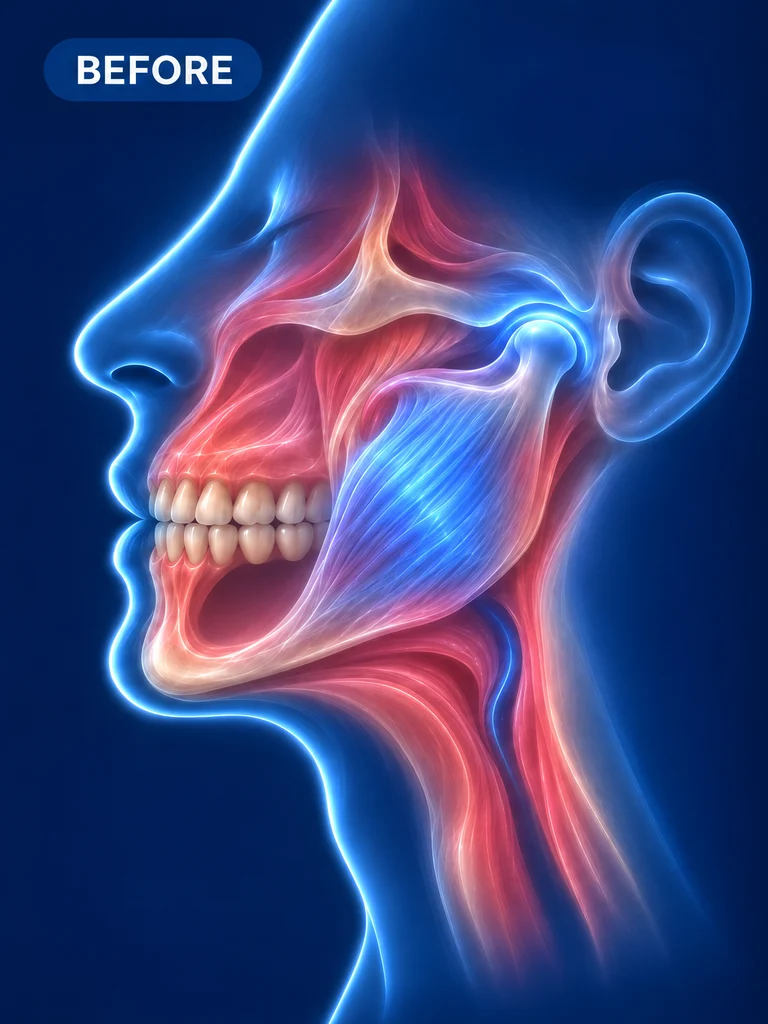
The TMJ is the hinge where your jaw meets your skull. Clenching, grinding, or a bite that does not meet evenly loads it, and the muscles around it, day after day.
When the airway narrows during sleep, the body can clench or grind to brace it open. Night after night, that bracing can strain the joint, and it's often overlooked.
Dr. Trivedi looks at the joint, the bite, and the airway as one system, so the plan aims at what is driving the strain, not just where it hurts.

How it works
In four steps. We look before we treat, so every part of your plan ties back to what we found.
Start with a complimentary consultationTalk through what you are noticing with an Airway Coordinator. No cost, no commitment.
Breathing, structure, and function assessed together, with CBCT imaging and an overnight sleep ring when they add clarity.
Your imaging, bite, and jaw movement, plus sleep data if you add it, show what is loading the joint: the bite, muscle tension, clenching tied to breathing, or a mix.
Dr. Trivedi walks you through each stage and what it's designed to do. When the airway is involved, the plan may include palatal expansion or aligners.
What to expect
A conversation about where it hurts, when it started, what makes it worse, and what you have tried so far, like a night guard.
An exam of the joint, your jaw movement, and your bite, plus 3D CBCT imaging. A sleep analysis with a sleep ring can be added.
Dr. Trivedi reviews your findings with you, including whether your airway plays a part, and lays out next steps. Results vary.
Who you'll see

When someone clenches all night, we look at what the airway is doing, not just the teeth, so the plan is built to ease strain on the joint.
Dr. Ameet Trivedi, DDS · Airway Health Specialist, 20+ years of clinical experience
Questions
It depends. Clicking on its own is not always a concern. Clicking that comes with pain, locking, or trouble chewing or speaking is worth an evaluation.
Not always. Clenching has many causes, but it can be one sign of strained breathing during sleep. If your evaluation points that way, Dr. Trivedi may recommend a sleep analysis. A SleepImage physician reviews the results and makes any diagnosis.
No one can promise that. Your plan aims to take load off the joint by addressing what is driving it, whether that is the bite, clenching, or the airway. Results vary and are not guaranteed.
Not always. Aligners are one option when the bite is part of the strain, including for people who already had braces. Your evaluation shows what is loading the joint, and the plan follows from that.
It depends on your plan. Your timeline follows from what the evaluation finds, and Dr. Trivedi walks you through it before anything starts.
We do not bill insurance directly. We provide the codes you need to submit for reimbursement.
Tell an Airway Coordinator about your jaw pain, clicking, or clenching, and they can help you pick the right first step.
Start here
$0
A call with an Airway Coordinator to talk through symptoms and next steps.
In Austin
$300/500
Credited toward treatment if you proceed; conditions apply.
$300 for pediatric (ages 3-12) / $500 for adults (13+)
Outside Austin
$380
Meet Dr. Trivedi by video for specialized guidance, no travel needed.
Prefer to talk now? Call (512) 500-6228
Educational only, not a substitute for professional advice. Results vary and are not guaranteed.
The temporomandibular joint (TMJ) acts as a hinge connecting your jawbone to your skull, enabling essential functions like chewing and speaking. Because of its complex structure, this joint is highly susceptible to dysfunction.
TMJ pain or dysfunction (TMD) can develop from stress on the joint caused by bite misalignment, clenching, grinding, or — often overlooked — airway restriction. Without treatment, TMD tends to worsen over time, contributing to chronic discomfort and compensatory patterns throughout the head, neck, and shoulders.
If you’re experiencing any of these, a thorough evaluation can identify the contributing factors and determine the best path forward.
Care at Airway Health Austin begins with a detailed, integrative assessment. Using advanced diagnostic tools, we evaluate bite alignment, jaw movement patterns, and overall oral and airway health to identify the true source of your symptoms.
Every patient presents differently, and treatment is customized accordingly. Common solutions include:
One of the most commonly missed contributors to TMJ disorders is airway restriction. When breathing is compromised during sleep, the body compensates — often through jaw clenching, grinding, and postural changes that place chronic stress on the TMJ.
Airway Health Austin specializes in recognizing this connection. Using epigenetic maxillary expansion techniques, we work to naturally develop the upper and lower jaws to improve airway function, which can significantly reduce TMJ pain and resolve associated sleep apnea concerns.
Your evaluation at Airway Health Austin includes a thorough examination of your jaw, teeth, and airway. From there, we identify the specific factors contributing to your TMJ disorder — whether that’s bite alignment, muscle tension, stress, or airway restriction — and develop a step-by-step treatment plan tailored to your needs.
Book a complimentary consultation at Airway Health Austin and take the first step toward a jaw that functions the way it should.