Palatal expansion for better sleep.
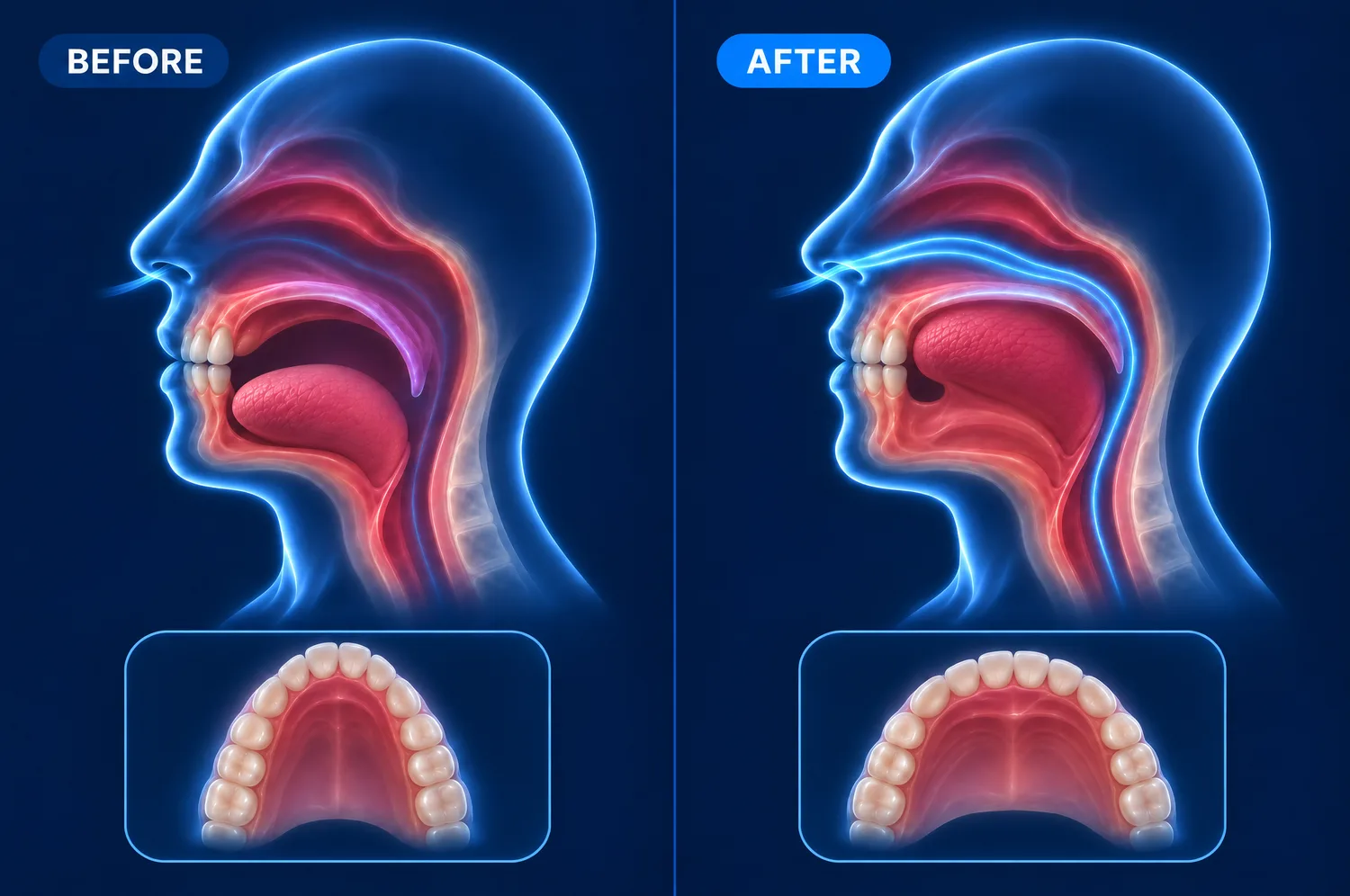
A narrow palate and small jaws leave the tongue too little room, so it rests low and back and crowds the airway in sleep. We map that structure in 3D and widen the upper jaw for better breathing and sleep.

Led by Dr. Ameet Trivedi, Airway Health Specialist

The short answer
Airway expansion is root-cause airway care for symptoms associated with sleep apnea. At Airway Health Austin, Dr. Trivedi widens a narrow upper jaw to give the tongue and nasal airflow more room during sleep. We address the structure behind the symptoms, then retrain the tongue to use that space for proper function and airway stability.
Is this you?
If two or more of these sound familiar, it's worth a closer look.
At night
By day
Often ignored
The root cause
As you fall asleep, the throat muscles relax. If the airway is already narrow, breathing takes more effort, sleep is disrupted, and you wake unrested.
Small jaws and a narrow palate leave the tongue too little space, so it rests low and back toward the throat and crowds the airway. Diet, early feeding habits and genetics can all play a part.
Expansion aims to give the tongue room to rest higher and air more room to move through the nose so you can breathe easier and more efficiently.


How it works
In four steps: your structure, mapped and planned in 3D.
Start with a complimentary consultationTalk through what you are noticing with an Airway Coordinator. No cost, no commitment.
Breathing, structure, and function assessed together, with CBCT imaging and an overnight sleep ring when they add clarity.
Your CBCT scan, photos and head and neck measurements show the width of your palate and jaws. Dr. Trivedi builds the plan around your anatomy and goals.
A fixed MASPE+ expander or the removable Biomimetic Remodeling Expansion Aligner System (BREAS) widens the upper jaw gradually, with periodic check-ins.
What to expect
An Airway Evaluation maps your structure with 3D CBCT imaging. If you add a sleep analysis, a SleepImage physician reviews it.
Widening is gradual, with periodic visits to adjust the appliance and to see how your sleep and daytime symptoms are changing.
Myofunctional therapy trains proper tongue function so it can learn to use the new space. Results vary from person to person.
Who you'll see

We look at the structure behind the symptoms: giving the tongue and the airway more room to work with during sleep.
Dr. Ameet Trivedi, DDS · Airway Health Specialist, 20+ years of clinical experience
Questions
No. We address the symptoms associated with sleep apnea at their structural root, such as a narrow palate, small jaws or a low tongue. If you add a sleep analysis, a SleepImage physician reviews it and makes any diagnosis.
No. Airway expansion is not a replacement for CPAP, so keep using CPAP as prescribed. Expansion works on the structure around the airway, a factor behind many symptoms associated with sleep apnea.
Start with a complimentary consultation. If your symptoms suggest sleep apnea, Dr. Trivedi may recommend a sleep analysis. A SleepImage physician reviews the results and makes any diagnosis.
It's not jaw surgery. BREAS is a removable appliance, and MASPE+ is a fixed expander anchored to the palate with small miniscrews. Your treatment plan spells out what each step involves.
It depends on the appliance. With BREAS, treatment runs in two parts: palate expansion (about 4 months), then orthodontic alignment (about 6 months). Periodic visits track progress, and your plan lays out each stage before you begin.
It can, but it's not guaranteed. Expansion is designed to give the tongue and nasal airflow more room, which can ease snoring and related symptoms for many people. Results vary.
We do not bill insurance directly. We provide the codes you need to submit for reimbursement.
Start by talking with an Airway Coordinator. If expansion may fit, an evaluation maps your jaws, palate and airway.
Start here
$0
A call with an Airway Coordinator to talk through symptoms and next steps.
In Austin
$300/500
Credited toward treatment if you proceed; conditions apply.
$300 for pediatric (ages 3-12) / $500 for adults (13+)
Outside Austin
$380
Meet Dr. Trivedi by video for specialized guidance, no travel needed.
Prefer to talk now? Call (512) 500-6228
Educational only, not a substitute for professional advice. Results vary and are not guaranteed.
Sleep apnea, including Obstructive Sleep Apnea (OSA) and Upper Airway Resistance Syndrome (UARS), occurs when airflow through the upper airway is disrupted during sleep. The result: poor sleep quality, chronic fatigue, and wide-ranging health consequences.
Both conditions commonly stem from underdevelopment of the maxilla (upper jaw) and mandible (lower jaw). When the jaws don't develop to their full size, the mouth and nasal passages are restricted. The tongue is squeezed down and back toward the throat — either collapsing the airway (OSA) or narrowing the nasal or throat passages (UARS).
Sleep apnea is a medical condition diagnosed by physicians. What we treat are the craniofacial deficiencies — the underdeveloped jaw structure and restricted airway anatomy — that create the conditions for it to occur.
Our approach centers on airway expansion — creating more physical space for the tongue and nasal cavity so airflow can improve naturally. We focus on the underlying craniofacial deficiencies that restrict the airway in the first place.
CPAP keeps the airway open during sleep, while expansion works on the structure of the airway itself. Airway care doesn't replace CPAP or any therapy a physician prescribes, so keep using CPAP as prescribed.
Using Epigenetic Maxillary Expansion, we stimulate natural bone growth along the palatal suture with a Biomimetic Remodeling Expansion Aligner System (BREAS). The BREAS is a removable appliance that mimics the body's natural growth biology to expand the upper jaw gradually and permanently.
It's not a retainer, and it doesn't replace CPAP.
Your journey begins with a comprehensive evaluation at Airway Health Austin. We collect medical-dentofacial records including a home sleep study, CBCT scan, intraoral and extraoral photos, and head and neck measurements. This data is used to build a treatment plan tailored to your anatomy and goals.
BREAS treatment runs in two parts: palate expansion (about 4 months), then orthodontic alignment (about 6 months), with periodic visits to monitor progress and adjust appliances. Many patients begin noticing improvements in sleep quality within the first few days or weeks of treatment.
Schedule a structural evaluation at Airway Health Austin and find out if airway expansion treatment is right for you.