Complimentary consultation

Your call is booked.

Your confirmation is on its way to your inbox. Before you talk with your Airway Coordinator, Dr. Trivedi has a short message for you.

Call 512-500-6228
  • ComplimentaryNo cost, no commitment
  • By phoneWith an Airway Coordinator
  • Your questionsBring your list
  • Need to move it?Call 512-500-6228
Before your call

Dr. Trivedi’s one request: bring your questions.

Three small things now make the conversation far more useful to you.

  1. Write down your questionsEverything you want to ask about your sleep, your breathing or your jaw. Nothing is too small.
  2. Note what you have noticedSnoring, mouth breathing, waking up tired, jaw tension, and anything you have already tried.
  3. Pick a quiet spotSomewhere you can talk freely. If you are under 18, have a parent or guardian join you.
On your call

What will your Airway Coordinator do?

First

Answer your questions

Every one on your list, in plain language.

Then

Explain the why

Help you understand what may be behind your symptoms.

Last

Map your options

The root cause solutions available to you, and the next step if you want one.

The short answer

What is airway restriction?

Airway restriction means the space you breathe through is tighter than it should be. A narrow palate and small jaws leave the tongue too little room, so it rests low and back and crowds the airway, most of all when you lie down to sleep.

Side view illustration of a head: the tongue sits low and back, the jaw is small and set back, and the airway behind the tongue is narrow.
Illustration, not a patient photo.
The bigger picture

What is disordered breathing?

Snoring, mouth breathing and waking up unrested can sit on one continuum, even when a sleep study comes back normal. We look at your jaws, palate, tongue and breathing together to see what is behind it.

Physicians diagnose sleep apnea. We look at the structure behind the symptoms and work alongside your physician.
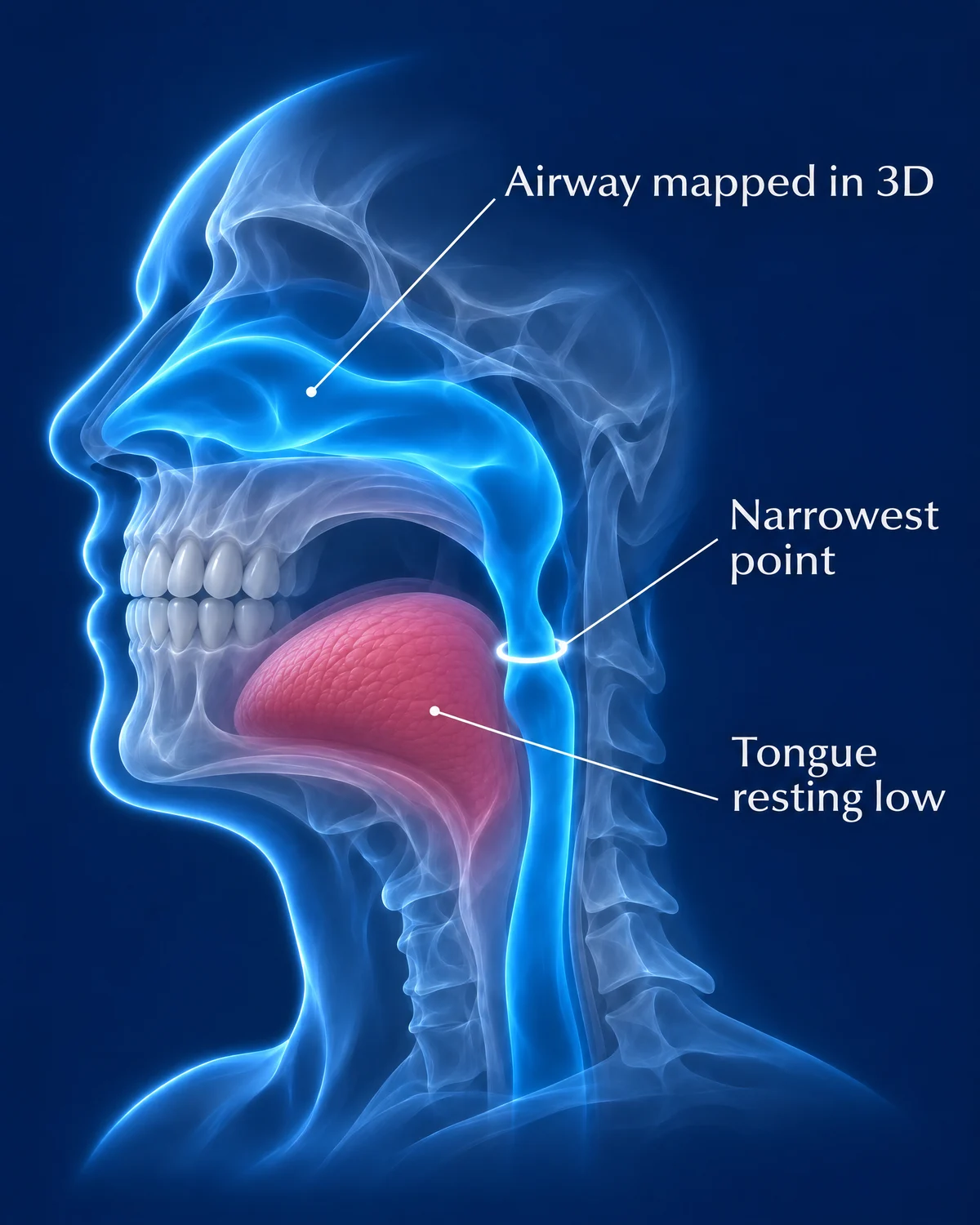
Illustration of an airway mapped in 3D, with the narrowest point marked behind a low resting tongue.
Illustration, not a patient scan.
The root cause

How does palatal expansion help?

01 · The problem

A narrow upper jaw

The palate is the roof of your mouth and the floor of your nose. When it is narrow, both are crowded.

02 · The root cause

Less room to breathe

The tongue has nowhere to rest, so it sits low and back, and nasal airflow has less space.

03 · The solution

Widen the palate

Widening a narrow upper jaw gives the tongue and nasal airflow more room. Whether expansion fits you, and which kind, depends on your evaluation.
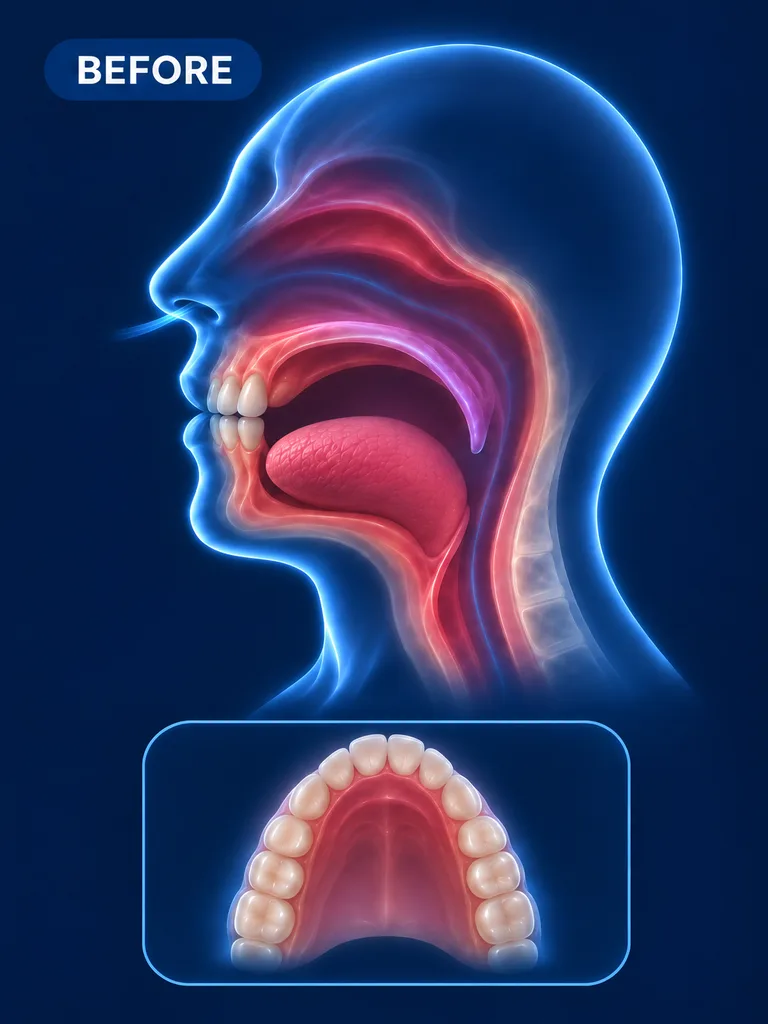
Before: side view with a narrow palate shown from below, the tongue resting low.
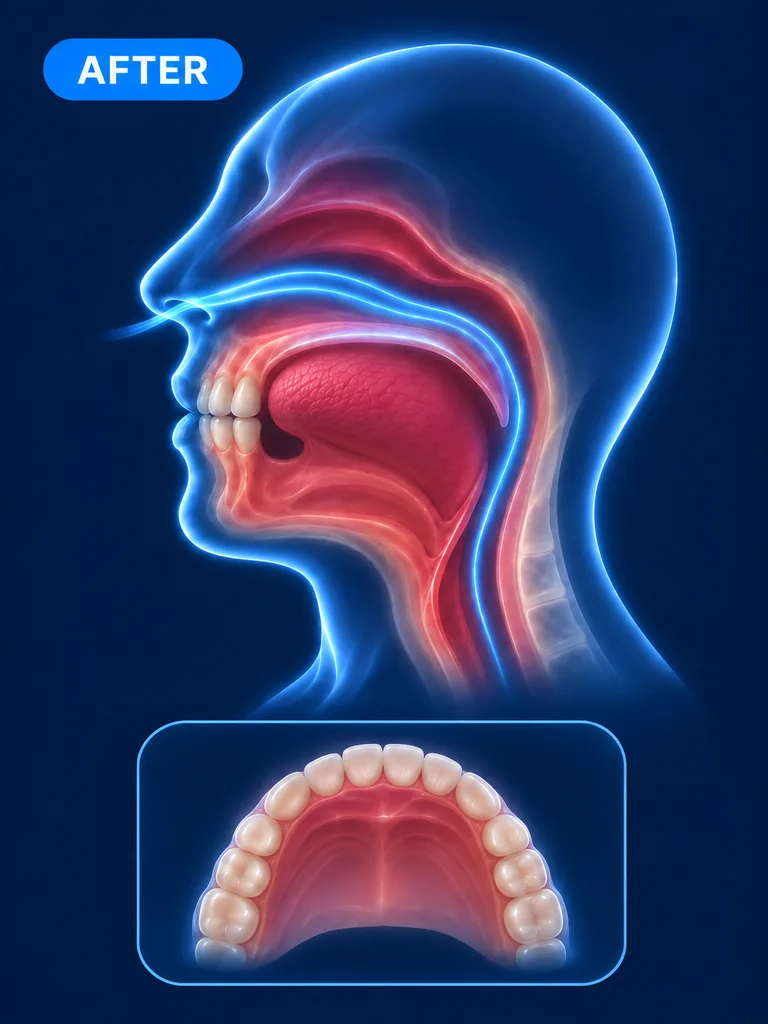
After: the palate is wider, the tongue rests up on it and the airway behind it is more open.
Illustration. Before: narrow palate, tongue resting low. After: wider palate, tongue up, more open airway. Individual results vary.
In their words
“I struggled with chronic fatigue, nasal congestion and TMJ pain. After working with Airway Health, my issues resolved. I breathe easier, sleep better, feel more energized, and my smile looks amazing.”
John S. · 35, Austin, TX
Patient stories

Hear it from patients.

Talk soon.

We look forward to speaking soon and supporting you on your airway journey.

This page is educational and is not medical advice or a diagnosis. Illustrations are simplified. Patient experiences are individual, and results vary with age, anatomy and other factors.