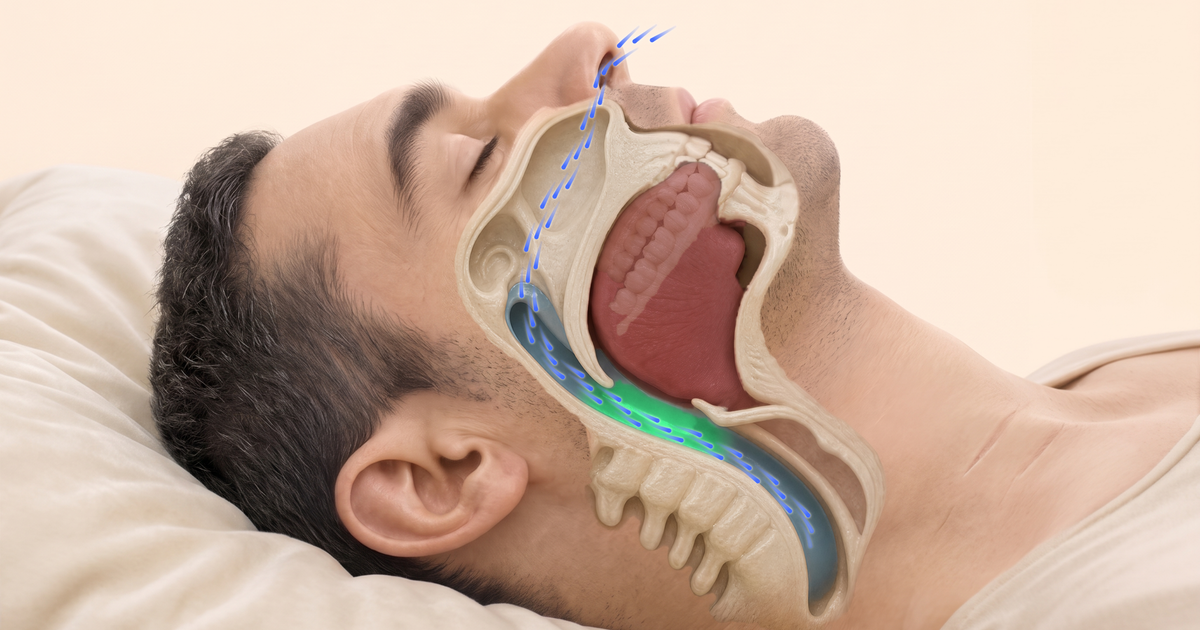
TL;DR: Chronic mouth breathing is usually a structural problem, not a bad habit. When the palate is narrow and the tongue rests low in the mouth instead of against the roof, the airway restricts and the mouth takes over the work of breathing. Airway Health Austin, led by Dr. Ameet Trivedi, DDS, uses CBCT 3D airway imaging to map the craniofacial structure, then creates space through palatal expansion so the tongue can rest high and nasal breathing becomes the path of least resistance.
You were probably told to just close your mouth. Maybe you tape your lips at night, take allergy pills, or run a humidifier and still wake up with a dry throat. The habit advice never stuck because mouth breathing is rarely a habit. It's a response to a structure that does not leave room to breathe through the nose comfortably, so learning how to stop mouth breathing means changing that structure, not forcing your lips shut.
You cannot stop mouth breathing by willpower when the underlying issue is a narrow palate and low tongue posture. The roof of the mouth is also the floor of the nasal cavity. When the upper jaw developed too narrow, the nasal passages above it are narrow too, so air meets resistance and the body defaults to the open mouth for easier airflow. This is a craniofacial deficiency, a structural shortfall in how the jaws and palate developed, not a character flaw.
Low tongue posture reinforces the pattern. The tongue is meant to rest against the roof of the mouth, where it supports the palate and keeps the airway open. When the tongue sits low on the floor of the mouth, the palate loses that support and the airway stays crowded, which keeps the mouth open to compensate.
Low tongue posture means the tongue rests on the floor of the mouth instead of sealed against the palate, and it both signals and sustains a restricted airway. A tongue that cannot reach the roof of the mouth, sometimes because of a tongue-tie, sometimes because there is simply no room, leaves the palate unsupported and the nasal airway underused.
Over years, this shapes the face and bite. Low tongue posture is associated with a narrower upper arch, crowded teeth, a longer face pattern, and a habitually open mouth. Addressing where the tongue rests is central to shifting someone from mouth breathing back to nasal breathing.
The durable path from mouth breathing to nasal breathing is to widen the structure so the nasal airway opens and the tongue has a high resting place to seal against. At Airway Health Austin, Dr. Trivedi starts with cone beam CT imaging to measure airway volume and see exactly where the restriction lives, then designs an AERIS Protocol, the complete personalized plan, around that anatomy.
Skeletal and palatal expansion widens the upper jaw, which widens the nasal floor above it. Expansion options include MASPE+ (a Miniscrew-Assisted Slow Palatal Expander that works without braces) and BREAS (Biomimetic Remodeling Expansion Aligner System), a removable palatal remodeler. As the palate widens, the tongue gains room to rise and seal, nasal airflow increases, and the mouth is no longer doing a job it was never meant to do.
Myofunctional therapy and, where indicated, tongue-tie release support the new posture so the tongue learns to stay high. Traditional orthodontics often pulls teeth to fit a crowded arch, which can narrow the space the tongue and airway need; this approach expands the arch instead to open that space.
Airway Health Austin treats the structural root of mouth breathing rather than managing the symptoms around it. Dr. Trivedi brings 20-plus years of clinical experience and pairs CBCT 3D airway imaging with a medical-grade overnight sleep ring, so the change you make is measurable, not assumed.
One patient shared roughly a 30 percent improvement in physiological performance within the first three days and nearly 50 percent after 17 weeks, without drugs or surgery. That is one person's experience, shared to show what root-cause change can look like, not a promise of a typical result.
If you have cycled through tape, sprays, and night guards and still breathe through your mouth, the next step is to see the structure. Book a complimentary consultation with an Airway Coordinator, or call (512) 500-6228, and start with imaging that shows your airway, your palate, and where your tongue actually rests. Transform your breathing. Transform your life.
In many adults and children, chronic mouth breathing traces back to a narrow palate and low tongue posture that make nasal breathing harder, which is a structural issue. CBCT imaging at Airway Health Austin can show whether the nasal airway is crowded by how the jaws developed.
Yes, adults can undergo palatal expansion to widen the upper jaw and open the nasal floor. Appliances such as MASPE+ and the BREAS removable aligner system are designed to create that space without braces, and results vary by individual anatomy.
Low tongue posture leaves the palate unsupported and is associated with a narrower arch, crowded teeth, and a habitually open mouth over time. Restoring a high tongue rest position is a core part of shifting from mouth breathing to nasal breathing.
The first step is a complimentary consultation with an Airway Coordinator, followed by an evaluation that may include CBCT 3D airway imaging and an overnight sleep ring. Evaluation options include an Airway Evaluation at $500 for ages 13 and up, a Pediatric Evaluation at $300 for ages 3 to 12, and a three-night Sleep Analysis at $350.
This article is educational only and is not a substitute for professional medical or dental advice. Results vary and are not guaranteed. Imaging supports but does not replace clinical evaluation. Visiting this site does not create a doctor-patient relationship. Airway Health Austin does not bill insurance and provides codes for reimbursement.